Hadoop
Introduction to Hadoop
INTRODUCTION:
Hadoop is an open-source software framework that is used for storing and processing large amounts of data in a distributed computing environment. It is designed to handle big data and is based on the MapReduce programming model, which allows for the parallel processing of large datasets.
What is Hadoop?
Hadoop is an open source software programming framework for storing a large amount of data and performing the computation. Its framework is based on Java programming with some native code in C and shell scripts.
Hadoop is an open-source software framework that is used for storing and processing large amounts of data in a distributed computing environment. It is designed to handle big data and is based on the MapReduce programming model, which allows for the parallel processing of large datasets.
Hadoop has two main components:
- HDFS (Hadoop Distributed File System): This is the storage component of Hadoop, which allows for the storage of large amounts of data across multiple machines. It is designed to work with commodity hardware, which makes it cost-effective.
- YARN (Yet Another Resource Negotiator): This is the resource management component of Hadoop, which manages the allocation of resources (such as CPU and memory) for processing the data stored in HDFS.
- Hadoop also includes several additional modules that provide additional functionality, such as Hive (a SQL-like query language), Pig (a high-level platform for creating MapReduce programs), and HBase (a non-relational, distributed database).
- Hadoop is commonly used in big data scenarios such as data warehousing, business intelligence, and machine learning. It’s also used for data processing, data analysis, and data mining. It enables the distributed processing of large data sets across clusters of computers using a simple programming model.
History of Hadoop
Apache Software Foundation is the developers of Hadoop, and it’s co-founders are Doug Cutting and Mike Cafarella. It’s co-founder Doug Cutting named it on his son’s toy elephant. In October 2003 the first paper release was Google File System. In January 2006, MapReduce development started on the Apache Nutch which consisted of around 6000 lines coding for it and around 5000 lines coding for HDFS. In April 2006 Hadoop 0.1.0 was released.
Hadoop is an open-source software framework for storing and processing big data. It was created by Apache Software Foundation in 2006, based on a white paper written by Google in 2003 that described the Google File System (GFS) and the MapReduce programming model. The Hadoop framework allows for the distributed processing of large data sets across clusters of computers using simple programming models. It is designed to scale up from single servers to thousands of machines, each offering local computation and storage. It is used by many organizations, including Yahoo, Facebook, and IBM, for a variety of purposes such as data warehousing, log processing, and research. Hadoop has been widely adopted in the industry and has become a key technology for big data processing.
Features of hadoop:
1. it is fault tolerance.
2. it is highly available.
3. it’s programming is easy.
4. it have huge flexible storage.
5. it is low cost.
Hadoop has several key features that make it well-suited for big data processing:
- Distributed Storage: Hadoop stores large data sets across multiple machines, allowing for the storage and processing of extremely large amounts of data.
- Scalability: Hadoop can scale from a single server to thousands of machines, making it easy to add more capacity as needed.
- Fault-Tolerance: Hadoop is designed to be highly fault-tolerant, meaning it can continue to operate even in the presence of hardware failures.
- Data locality: Hadoop provides data locality feature, where the data is stored on the same node where it will be processed, this feature helps to reduce the network traffic and improve the performance
- High Availability: Hadoop provides High Availability feature, which helps to make sure that the data is always available and is not lost.
- Flexible Data Processing: Hadoop’s MapReduce programming model allows for the processing of data in a distributed fashion, making it easy to implement a wide variety of data processing tasks.
- Data Integrity: Hadoop provides built-in checksum feature, which helps to ensure that the data stored is consistent and correct.
- Data Replication: Hadoop provides data replication feature, which helps to replicate the data across the cluster for fault tolerance.
- Data Compression: Hadoop provides built-in data compression feature, which helps to reduce the storage space and improve the performance.
- YARN: A resource management platform that allows multiple data processing engines like real-time streaming, batch processing, and interactive SQL, to run and process data stored in HDFS.
Hadoop Distributed File System
It has distributed file system known as HDFS and this HDFS splits files into blocks and sends them across various nodes in form of large clusters. Also in case of a node failure, the system operates and data transfer takes place between the nodes which are facilitated by HDFS.
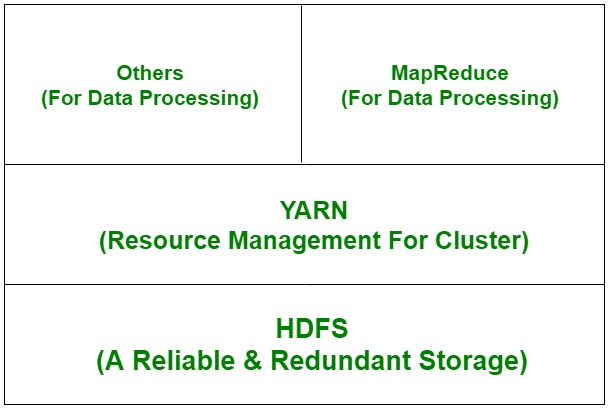
HDFS
Advantages of HDFS: It is inexpensive, immutable in nature, stores data reliably, ability to tolerate faults, scalable, block structured, can process a large amount of data simultaneously and many more. Disadvantages of HDFS: It’s the biggest disadvantage is that it is not fit for small quantities of data. Also, it has issues related to potential stability, restrictive and rough in nature. Hadoop also supports a wide range of software packages such as Apache Flumes, Apache Oozie, Apache HBase, Apache Sqoop, Apache Spark, Apache Storm, Apache Pig, Apache Hive, Apache Phoenix, Cloudera Impala.

Comments
Post a Comment